
Getting a product onto Thailand’s modern trade shelves (hypermarkets, convenience stores, supermarkets) can cost more than half the retail price. Euromonitor gives you channel breakdowns, but the real cost of getting on the shelf is much harder to find.
“We want to expand into Thailand, but we don’t know what distribution actually costs.”
This is a question I hear regularly from consumer goods companies looking at the Thai market.
The truth is, most of this information only exists in Thai-language industry media and forums. Based on Thai-language sources, here is what it really costs to get a product onto a Thai retail shelf.
(This article contains tables. If they don’t display well, you can read the same content on our website)
Three Conglomerates Control Thailand’s Food Retail
Modern trade (MT) accounts for 61% of Thailand’s food retail, dominated by three conglomerates: CP Group, TCC Group, and Central Group.
| Channel | Share |
|---|---|
| Modern Trade (MT) | 61% |
| Traditional Trade (TT) | 25% |
| E-commerce | 14% |
In hypermarkets alone, Lotus’s (CP) holds 46.79% and Big C (TCC) holds 38.56% — the top two chains control over 85%.
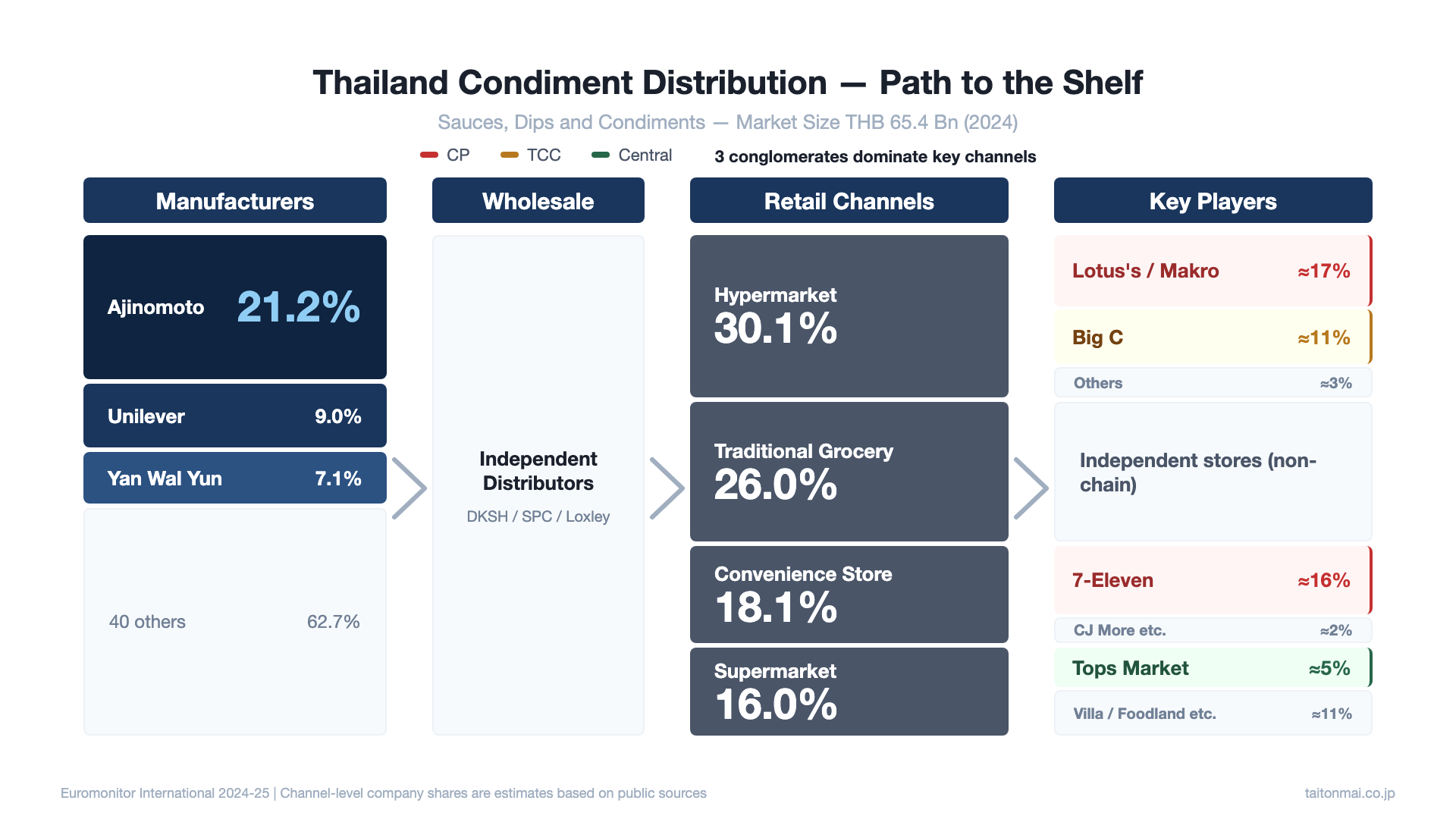
The chart below shows the distribution structure for the Sauces, Dips and Condiments category.
So far, this is all available in English-language reports. The real question is “how much does it cost to get on the shelf?” — and that requires searching in Thai.
Before You Stock a Single Item: Account Opening and Entrance Fees
To start doing business with an MT chain, you must pay an Open Account fee of 50,000–100,000 THB (USD 1,400–2,800) per chain — before placing a single product.
On top of that, there’s an Entrance Fee (also called Listing Fee):
| Retail Format | Entrance Fee |
|---|---|
| Hypermarket (1–4 SKUs) | 5,000 THB (USD 140) |
| Typical MT chain | 10,000–100,000 THB (USD 280–2,800) |
| 7-Eleven (nationwide, ~14,000 stores) | 1,000,000 THB (USD 28,000) per SKU |
7-Eleven’s 1,000,000 THB sounds steep, but it covers distribution to approximately 14,000 stores — about 71 THB (USD 2) per store. Still, listing just 3 SKUs requires a USD 84,000 upfront investment. And there’s a 3–6 month review period — if sales targets aren’t met, the product is delisted and the Entrance Fee is not refunded.
Gross Profit Margins: 15%–50%, Depending on Negotiating Power
The GP (gross profit margin) taken by retail chains ranges from 15% to 50%, largely determined by brand power and negotiating leverage.
| Retail Format | GP Rate |
|---|---|
| Wholesale (Makro, etc.) | ~5% |
| Hypermarket | 15–25% |
| Convenience store | 30–40% |
On Thailand’s largest forum, Pantip, suppliers share their real experiences:
“On a 69 THB product with 40% GP, the retailer takes 28 THB. After DC fees and rebates, you need to manufacture for under 20 THB to make any profit at all.”
Even well-known international brands are treated as “new entrants” if Thai consumers don’t recognize them — and new entrants face higher GP demands.
Costs Keep Rising Every Year After Listing
The TTA (Trade Term Agreement) is an annual contract that adds over 10% of sales in additional costs. These terms only move in one direction — against the supplier.
Thailand’s independent media outlet 101 PUB describes it this way:
“Accept the TTA terms, or get delisted. Suppliers have almost no choice.”
Beyond Entrance Fees, suppliers face seven types of charges: rebates, DC fees (1–3% of sales), advertising contributions, grand opening discounts, EDI fees, and merchandising fees.
Payment terms compound the problem. Despite contractual Net 30 terms, the actual average payment period is approximately 62 days — calculated from CP ALL’s 2024 Annual Report. New entrants are often required to accept consignment terms (unsold inventory is returned), adding further cash flow pressure.
Add It All Up: More Than Half the Retail Price Disappears
When you total GP, DC fees, TTA costs, and distributor margins, over 50% of the retail price goes to distribution costs.
| Cost Component | % of Retail Price |
|---|---|
| GP (retail margin) | 20% |
| DC Fee | 2% |
| TTA additional costs | 10% |
| Distributor margin | 20% |
| Total | ~52% |
The manufacturer keeps less than 48% of the retail price — and must still cover raw materials, manufacturing, and logistics.
Most foreign manufacturers enter Thailand through local distributors such as DKSH, SPC, or Loxley. These firms handle TTA negotiations, field sales, and even social media marketing — but their margins run 15–25% of sales.
The Information Only Exists in Thai
Channel breakdowns and chain directories are available in English. But specific GP rates, Entrance Fee amounts, TTA mechanics, and actual payment terms are only found in Thai-language industry media and forums.
Understanding distribution costs in Southeast Asia requires access to local-language sources — a barrier that most market entry reports don’t address.
Sources:
- 101 PUB “อำนาจเหนือตลาดของโมเดิร์นเทรด” 2025
- BrandAge “7 เครื่องมือเรียกเก็บค่าใช้จ่ายจากซัพพลายเออร์” 2021
- BrandAge “Listing Fee คืออะไร” 2024
- ThaiFranchiseCenter “ทำไมต้องมี Listing Fee”
- Pantip (Thai forum) — modern trade threads
- JETRO “Thailand Food Distribution Survey” 2024
- Roland Berger “Unraveling Asia’s complex consumer landscape” 2023
- US Trade.gov “Thailand Distribution and Sales Channels”
- CP ALL “Annual Report 2024”
About the Researcher
Takashi Kinoshita — CEO, Taitonmai Co., Ltd.
- Graduate of Osaka University (Master’s)
- 8 years at SHARP Corporation in procurement
- Including 2 years as Procurement Manager at SHARP’s Thailand factory, managing local staff as the only Japanese manager on site
- Since founding Taitonmai: 80+ countries, 10,000+ companies, 350+ research projects